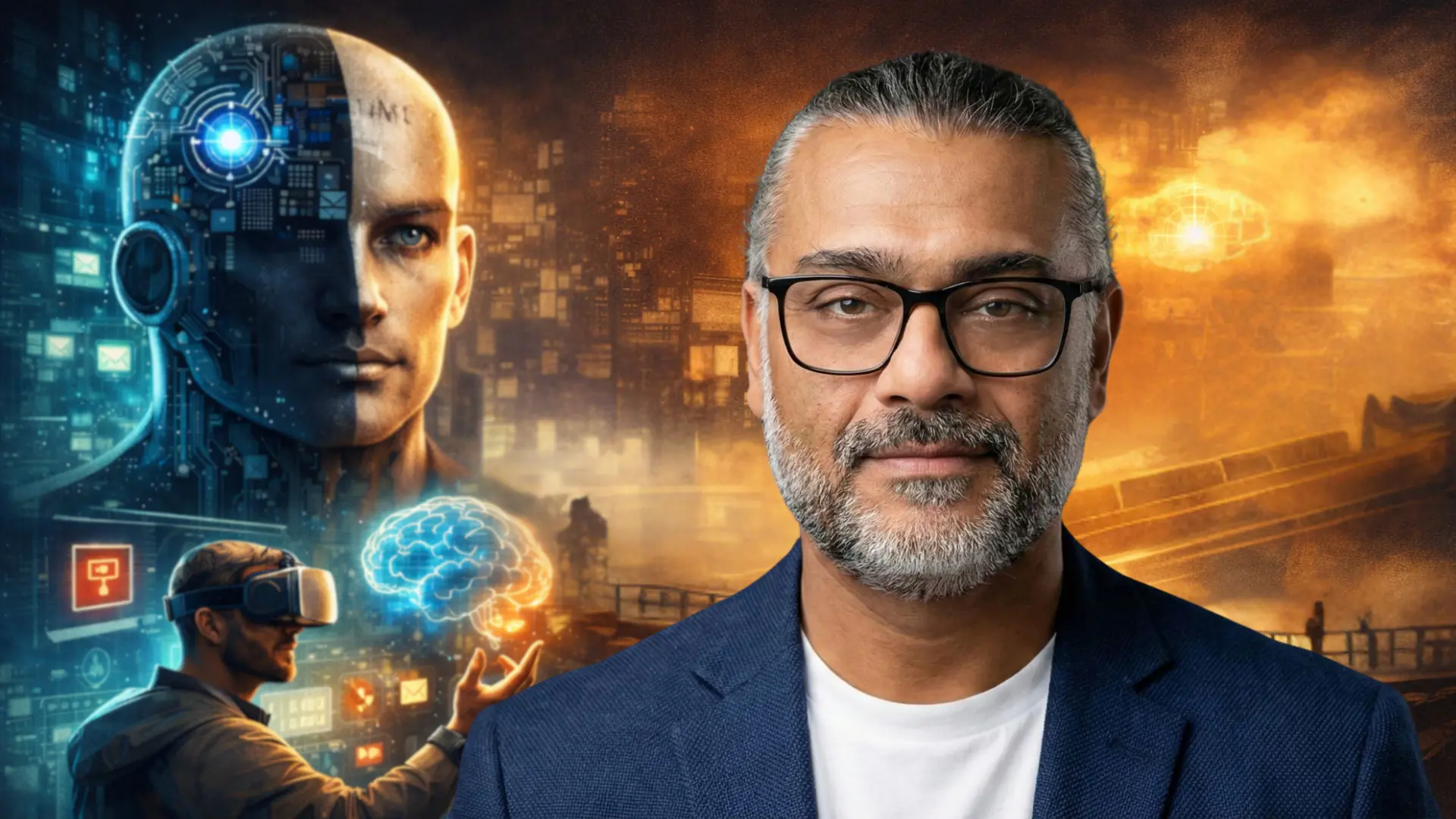

We are currently witnessing the greatest architectural shift in human history, but it isn’t happening in our cities. It’s happening inside our systems. As AI and XR transition from novelty to infrastructure, I think most organisations are making a fatal mistake: they are optimising for technical speed while ignoring human experience. When the gap between what a system can do and what a human can live with becomes too wide, innovation doesn’t just slow down, it fractures. In this article, I explore why the future of technology depends less on code and more on experiential literacy and why empathy is no longer a soft skill, but a core asset inside modern leadership.
As artificial intelligence and immersive technologies move from experimental playbooks into the backbone of global industry, a quiet crisis is emerging. It isn’t a crisis of technical capability, and it isn’t simply a lack of investment. It is a crisis of experience.
In my work navigating the frontiers of emerging technology, from the labs of Meta to senior leadership rooms in large organisations, I’ve seen a dangerous pattern repeat. We are building increasingly complex systems without paying enough attention to what it is actually like to live inside them. The innovation gap is widening. Systems are technically functional but culturally fragile. If we don’t address the human architecture of these technologies, the next decade of digital transformation won’t produce the progress we keep promising. It will produce a slow collapse of organisational trust.
The Illusion of Momentum
Across every sector, speed is being mistaken for direction. Organisations are automating decision-making and deploying XR training environments at pace. From the point of view of a spreadsheet, this looks like progress. Efficiency improves. Overheads drop. Throughput increases. The story is easy to tell.
From the inside, the view is often very different.
When an AI system handles hiring or an XR simulation is used to onboard a global workforce, these are not merely tools. They become digital habitats. They shape how people understand their role, their responsibility and their sense of agency. When those shifts are left unmanaged, people don’t truly engage with the system. They comply with it. They stop being curious and start being careful. This is the trust tax. When a system feels opaque, humans protect themselves. They defer to the algorithm to avoid blame. They stop taking creative risks and the culture begins to harden.
Here’s what that looks like in real terms. I’ve seen organisations roll out AI screening to “remove bias” and “speed up hiring”, only to discover months later that high-quality candidates were quietly dropping out because the process felt unnervingly unaccountable. Not because the candidates were anti-technology but because there was no human intelligibility to the system. People didn’t know what was being assessed, what counted or how to challenge an outcome without feeling like they were arguing with a machine. The result wasn’t efficiency. It was reputational drag, a talent problem and internal mistrust, precisely because trust wasn’t designed in.
And the same pattern appears in performance contexts. An AI dashboard can be introduced as “clarity” but it often lands as surveillance if it reduces a person’s work to narrow signals. Once employees feel watched rather than supported, behaviour shifts. People optimise for what is measured, even when it’s not what matters. That is how a technically successful system produces a culturally damaging outcome.
Empathy as Infrastructure: The Speculative Architect’s View
In corporate life, empathy is often treated as a soft value. It lives in mission statements. It gets assigned to HR and, ultimately, becomes something leaders mention when they want to signal care. In the age of AI and XR, that is a strategic mistake becuase empathy has to be treated as infrastructure.
In architecture, the job is not just to create an impressive structure. The job is to anticipate how it will be inhabited over time. You don’t measure a building’s success by the elegance of its blueprint but by whether people can live and work in it without confusion, stress or harm. Digital systems deserve the same seriousness. Empathy is the discipline of anticipating how a system will feel to operate within, especially under pressure. It helps you see the ghost in the machine such as the hidden assumptions, the emotional ripple effects or the psychological cost of opacity.
When I talk about empathy-led immersive strategy, I’m not suggesting we become “nicer”. I’m suggesting we become more rigorous and be mindful that we must build systems humans can inhabit without losing their sense of purpose or their willingness to take responsibility.
If an AI performance dashboard makes an employee feel watched rather than supported, that system has failed, regardless of how advanced it is. If an XR training environment overwhelms people or makes them feel exposed, it will look impressive in a demo and underperform in reality.
A useful way to think about this is that trust is not an outcome you “win” after deployment. Trust is something you build into the environment, early, as a structural property.
A Simple Framework: The Trust Architecture Test
When leaders ask me how to make this practical, I come back to a simple way of stress-testing a system before it spreads. I think of it as a trust architecture test. It isn’t complicated but it forces the right questions.
First, can people orient themselves inside the system quickly? Not “can they be trained” but can they understand what is happening well enough to feel steady rather than anxious. If someone can’t tell what the system is doing, they will assume the worst, even if the system is well-intentioned.
Second, does the system preserve agency in meaningful ways? This doesn’t mean giving people endless options. It means ensuring they still feel they have a role beyond obedience. If the system leaves people feeling like passengers, you will get compliance but you won’t get ownership.
Third, is accountability clear at the moment decisions matter? In AI-mediated environments, responsibility can blur fast. If nobody knows who owns an outcome, people become defensive and defensiveness kills learning and initiative.
Finally, does the system include a mechanism for reflection and repair? Every real system produces edge cases, mistakes and moments of friction. The question is whether your design can absorb those moments without turning them into resentment or fear.
If those four conditions are weak, trust won’t “arrive later.” It will erode early.
From Spectacle to Agency: Redefining “Immersive”
One of the greatest hurdles to genuine innovation is the industry’s obsession with spectacle. When people hear the word immersive, they think of headsets, haptics or high-fidelity graphics. They focus seems to always ben on the hardware of immersion rather than the psychology of it.
True immersion is not about sensory intensity but about agency.
A world-class immersive strategy moves a person from being a passive observer to being an active participant inside a system of consequences. Whether you are using XR for high-stakes surgical training or for leadership development, the point is not to impress someone with realism. The point is to make complexity liveable. Instead of explaining a complex system through a fifty-page document, you put a leader inside a scenario where the complexity shows up through action. That kind of learning stays with people because they have felt the trade-offs rather than merely heard them described.
A concrete example here is safety and operational training. I’ve seen XR training work brilliantly when it’s designed around decision points: moments where someone has to choose under pressure and experience the consequence. It stops being “content” and becomes rehearsal for judgement. But I’ve also seen XR fail when it becomes a glossy tour with no meaningful choices. People remember the visuals but they don’t change their behaviour. The difference is not budget, it’s design.
The ROI of the Human Element
For leaders focused on value, the human element is often treated as friction that should be optimised away. I think this is exactly backwards. In an automated world, the human element is the only thing that produces durable advantage.
As AI commoditises intelligence, the remaining differentiators are judgement and trust. Those are human. If your innovation strategy reduces those capacities in your workforce, you are devaluing your organisation’s most important assets. Empathy-led strategy is how you scale technical capability without flattening human potential. It creates a safe testing environment where failure is informative rather than fatal. It allows organisations to explore the ethical “what ifs” of a new deployment before they are forced to respond publicly to the consequences.
The Mandate for Future Leaders: Experiential Literacy
The challenge for modern leadership is no longer functional literacy. Plenty of leaders can explain what the tools do. The new mandate is experiential literacy: the ability to understand what it feels like to operate inside the systems you oversee.
Does your AI-driven workflow genuinely help managers make better judgements or does it quietly turn them into people who police metrics? Does your XR training genuinely bring teams closer or does it create a new divide between those who feel fluent in the environment and those who feel exposed by it? When a machine recommendation shapes an outcome, where does accountability actually sit, not in policy, but in practice?
These aren’t philosophical questions, they are governance questions. They determine whether a system produces initiative or defensiveness and they also determine whether people take responsibility or hide behind process.
Shaping Innovation That Can Be Lived With The future of AI and XR will not be determined by the speed of processors. It will be determined by the strength of the trust we build into the environments these technologies create.
We are at a crossroads, where we can either build black-box systems that demand human adaptation or we can architect environments that make responsibility easier to hold, not harder. My focus is helping organisations bridge that gap. We don’t need innovation that asks humans to act like machines, we need strategies that bring technological power back into alignment with human purpose.
This isn’t just about building tools but about shaping the conditions of everyday life inside organisations. If we treat empathy-led immersive strategy as infrastructure, we have a real chance of building a future people can actually live in, day to day, without losing trust in the system or in themselves.
About the Author
Adipat Virdi is a leading thinker and practitioner in immersive strategy, AI-enabled storytelling and empathy-led experience design. He works across enterprise, culture and public sector contexts, helping organisations close the innovation gap by making complex systems liveable, legible and trustworthy.
Send a request for Adipat Virdi


Booking and request
Send a booking request here for Adipat Virdi
Did you find the blog post inspiring? You can book Adipat Virdi for your event. Contact us today to learn more about the possibilities.
About the author
Adipat Virdi is a global voice on XR, empathy-led design and immersive strategy, helping organisations transform how audiences think, feel and engage.