
In the first article in this series, I explored the emergence of what I describe as the Belonging Economy. It reflects a growing shift in how audiences relate to experiences around them. People no longer want to remain passive observers. Increasingly, they want to participate in the environments they encounter and feel that their presence has meaning within them.
Recognising this shift raises an important question.
If audiences are no longer satisfied with simply watching stories unfold, how do we design experiences that allow them to genuinely participate?
Many organisations attempt to answer this question by introducing interactive elements or new technologies. Yet interactivity alone rarely produces meaningful engagement. A touchscreen, a branching narrative or a gamified interface might invite participation, but this does not necessarily create emotional connection.
True participation requires something deeper.
Over the past several years, through both my professional practice and research into immersive storytelling, I have been developing an approach to this challenge that I call the Empathy Engine Framework, or EEF. The framework emerged from a simple but powerful observation: participation only becomes meaningful when audiences feel emotionally connected to the experience they are entering.
Without that emotional alignment, interactivity quickly becomes superficial. People follow prompts, make selections and move through an environment, but the experience rarely leaves a lasting impression. Empathy provides the bridge that transforms interaction into something more significant.
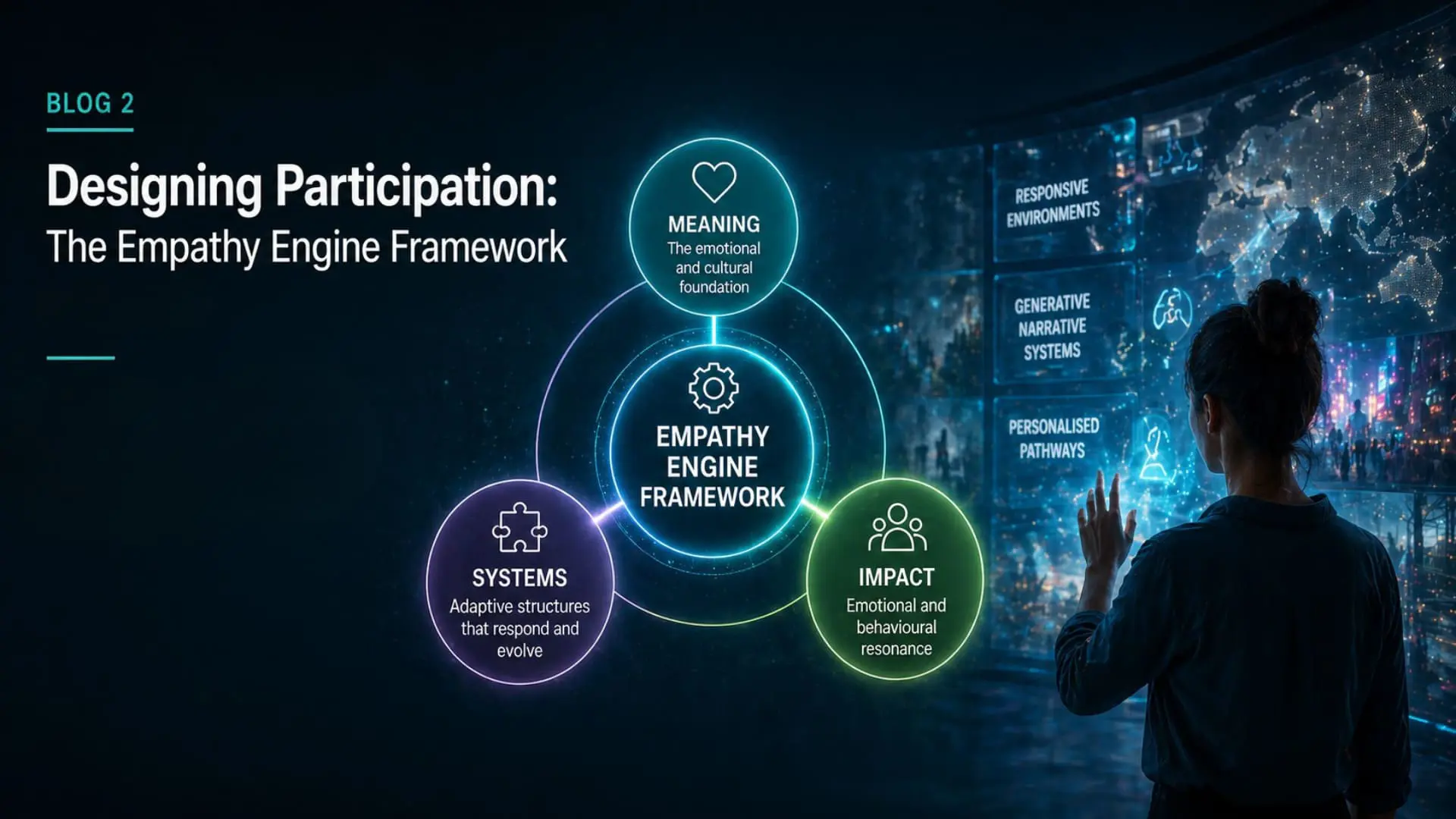
When people recognise themselves within an experience and feel that their presence matters, participation begins to evolve into collaboration. The Empathy Engine Framework translates this insight into a practical way of designing participatory environments. At its core are three interconnected dimensions that shape how experiences are created: meaning, systems and impact.
Meaning refers to the cultural and emotional foundation of an experience. Every immersive environment must begin with a clear sense of what it represents. What ideas or values does the experience explore? What emotional questions does it invite participants to engage with? What perspectives does it acknowledge or challenge?
Designing meaning requires careful attention to the symbolic language audiences respond to. Cultural references, narrative themes and identity signals all shape how people interpret the world they are entering. When these elements resonate, participants begin to recognise themselves within the storyworld. Engagement becomes personal rather than mechanical, because the environment speaks to something meaningful in their own experience.
If meaning defines intention, systems define structure.
Participatory experiences cannot rely on fixed narratives in the same way that traditional media does. Instead, they must function as adaptive environments capable of responding to the people moving through them.
Technology often plays an important role here, but not as spectacle. Rather, it acts as infrastructure that allows the experience to listen and respond.
Responsive environments, generative narrative systems and personalised pathways all allow an experience to evolve in relation to its participants. When this happens, agency becomes real. Participants feel that their presence influences the world around them, rather than simply guiding them through a predetermined sequence of events.
The third dimension of the framework focuses on impact.
For many years, the success of media experiences has been measured through exposure metrics such as views, impressions and engagement rates. While these indicators can provide useful information, they do not fully capture the deeper forms of connection that participatory environments can create.
Immersive experiences often influence how people think, feel and remember long after the event itself has ended. They create emotional memories and encourage reflection. Within the Empathy Engine Framework, impact therefore refers to the emotional and behavioural resonance an experience generates.
A project from my own work illustrates how these principles come together in practice. When I worked on the BBC’s interactive digital experience Syrian Journey, the goal was not simply to present information about migration. Instead, the experience invited participants to make a series of decisions that mirrored the difficult choices faced by refugees attempting to reach Europe.
Participants were asked to consider where to travel, who to trust and how to navigate increasingly dangerous circumstances. Each decision carried consequences, shaping the path that unfolded next. The experience did not simply tell the story of migration. It allowed participants to feel the uncertainty and pressure of those decisions themselves.
The result was a form of engagement that went beyond information. Participants were not merely learning about the issue; they were emotionally confronting it. This is the power of designing participation through empathy.
When meaning, systems and impact align, audiences stop behaving like users navigating a product. Instead, they begin to act as collaborators within a storyworld. Narratives evolve through participation and meaning is shaped collectively by the people inhabiting the environment.
Experiences start to feel less like campaigns or installations and more like living environments that grow alongside the communities engaging with them.
This is where belonging begins to emerge.
As the Belonging Economy continues to develop, organisations across many sectors will increasingly need structured ways of designing participatory environments. The Empathy Engine Framework offers one way of approaching this challenge. It reminds us that technology alone does not create powerful immersive experiences. People do.
And when experiences are designed around empathy, participation becomes something far more profound than interaction. It becomes the foundation for genuine human connection.
Send a request for Adipat Virdi


Booking and request
Send a booking request here for Adipat Virdi
Did you find the blog post inspiring? You can book Adipat Virdi for your event. Contact us today to learn more about the possibilities.
About the author
Adipat Virdi is a global voice on XR, empathy-led design and immersive strategy, helping organisations transform how audiences think, feel and engage.