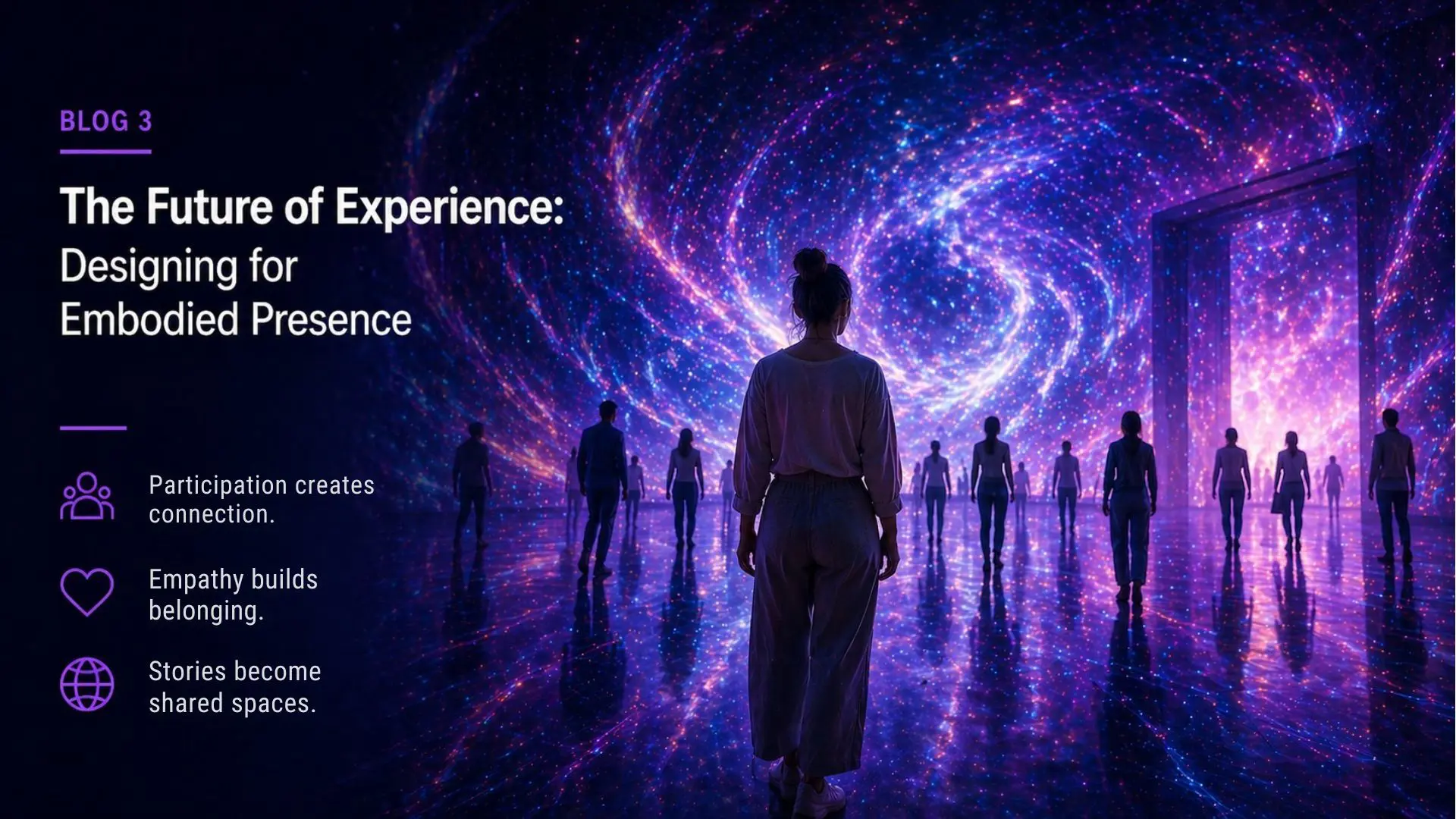

In the first two articles in this series, I explored the emergence of what I describe as the Belonging Economy and the design principles that support it through the Empathy Engine Framework. Together, these ideas reflect a wider shift in how audiences engage with media, brands and cultural environments. People are no longer satisfied with simply observing stories from the outside. Increasingly, they want to participate in them.
Yet participation is only part of the transformation that is taking place. The next stage goes further still. People are no longer simply interacting with experiences. They are beginning to inhabit them.
I describe this shift as embodied presence, and it represents a fundamental change in how audiences relate to narrative environments. When embodied presence is achieved, the audience is no longer positioned outside the experience looking in. Instead, they exist within the world itself.
This transformation changes the way we must think about storytelling.
For most of history, storytelling has been something audiences witness from a distance. Films, television, books and theatre all follow this structure. Characters navigate a narrative while audiences observe the journey unfold. Even when stories are emotionally powerful, there remains a clear boundary between the narrative world and the viewer.
Immersive environments begin to dissolve that boundary. Instead of watching a story unfold, participants step inside the storyworld. Their presence becomes part of the narrative environment. Their decisions influence how events unfold, and their emotional responses shape how the experience is interpreted.
Storytelling, in this context, begins to evolve into something closer to storyliving. The audience is no longer simply interpreting the story. They are experiencing it from within.
This shift also reveals a common misunderstanding about immersion. When immersive experiences are discussed, the conversation often focuses on technological spectacle. Advances in virtual reality, projection mapping and spatial computing are frequently presented as the defining features of immersive media.
Yet technology alone rarely creates immersion.
True immersion occurs when participants feel that their presence matters within the environment they are entering. It emerges when the world responds to them, when their actions carry consequences and when their identity is recognised within the experience. In other words, immersion is fundamentally emotional before it is technological.
This insight changes the way immersive environments must be designed.
Instead of focusing solely on producing content, creators begin designing worlds. These worlds must support exploration, interpretation and identity expression. Participants should feel able to move through the environment, discover meaning within it and shape their own journey through the experience. When this happens, experiences begin to resemble cultural spaces rather than media products. They become environments people inhabit, explore and share with others.
A useful example of this shift can be seen in large-scale immersive exhibitions that invite visitors to step inside works of art or narrative worlds. Rather than standing in front of a painting or watching a performance, audiences move through environments that surround them with story, sound and imagery. Their physical presence becomes part of the experience, shaping how they encounter and interpret the world around them.
The most successful of these environments do not simply overwhelm visitors with spectacle. Instead, they create spaces where people feel emotionally connected to what they are experiencing and to the people sharing that space with them.
When this happens, audiences stop behaving like spectators and begin behaving like communities. They discuss the experience with one another. They interpret its meaning collectively. They carry those conversations beyond the environment itself. What began as an exhibition or installation becomes a shared cultural moment.
This is the deeper potential of embodied presence.
As immersive technologies continue to evolve, from artificial intelligence and extended reality to spatial computing and responsive environments, the tools available to creators will undoubtedly become more sophisticated. Yet technology alone will not determine the future of experience design.
The real challenge is far more human.
How do we create environments where people feel recognised, empowered and connected? How do we design spaces that encourage empathy, curiosity and participation rather than passive consumption?
The organisations that answer these questions will not simply capture attention in the years ahead. They will build environments where audiences feel that they belong.
And in the emerging Belonging Economy, belonging may ultimately prove to be the most powerful experience of all.
Send a request for Adipat Virdi


Booking and request
Send a booking request here for Adipat Virdi
Did you find the blog post inspiring? You can book Adipat Virdi for your event. Contact us today to learn more about the possibilities.
About the author
Adipat Virdi is a global voice on XR, empathy-led design and immersive strategy, helping organisations transform how audiences think, feel and engage.