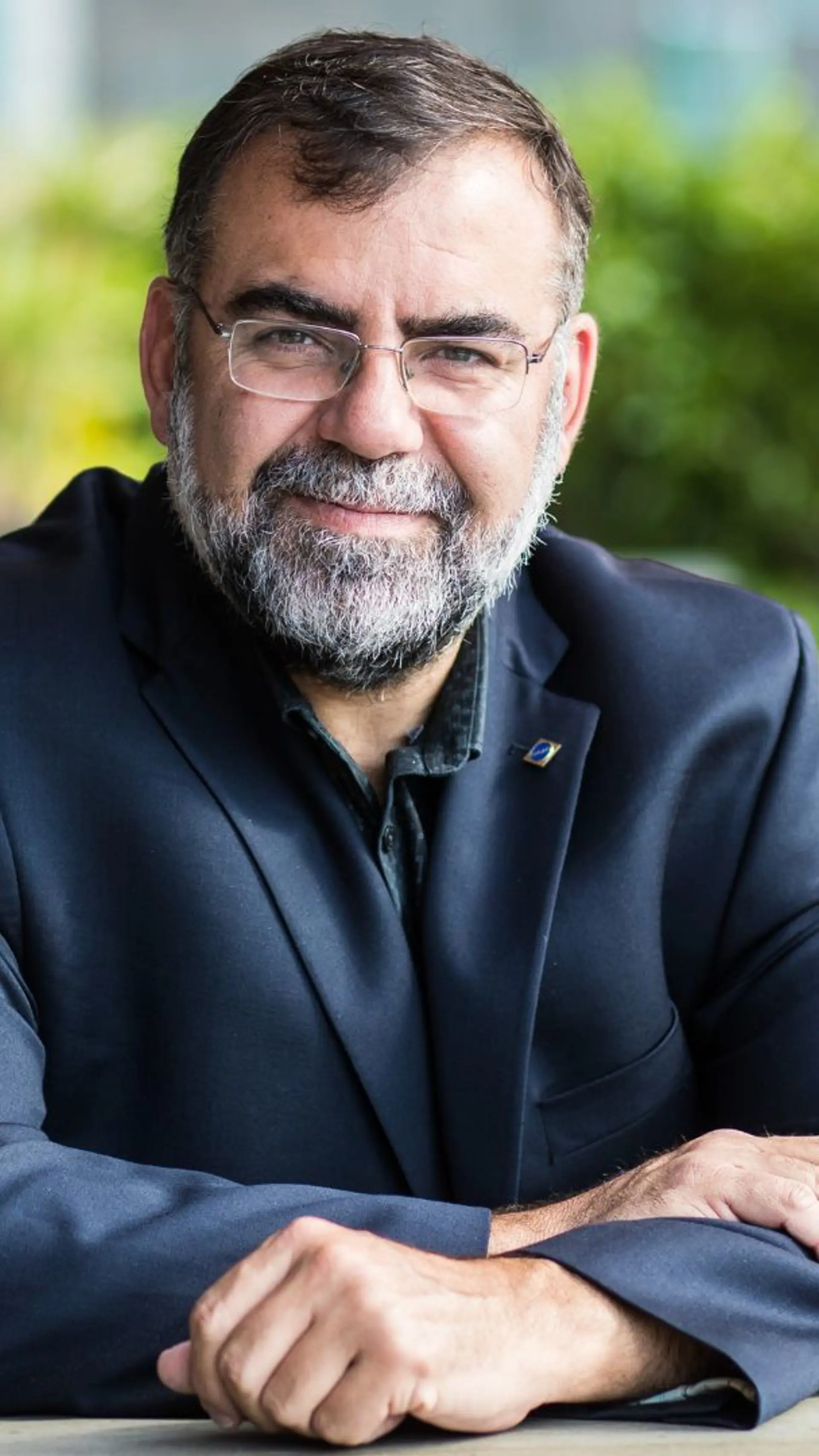
Ricardo Baeza-Yates
Ricardo Baeza-Yates is a globally recognized authority on responsible AI, web search and data science with decades of academic and industry leadership.
Ricardo Baeza-Yates is a globally recognized authority on responsible AI, web search and data science with decades of academic and industry leadership.
Ricardo Baeza-Yates is one of the most respected voices in computer science and artificial intelligence worldwide. With an exceptional career spanning academia, global technology companies and international AI policy bodies, he brings unmatched perspective on how algorithms, data and responsible AI shape society. As a professor at leading universities in Europe and Latin America, former VP of Research at Yahoo Labs, and a key contributor to global AI governance discussions, Ricardo Baeza-Yates delivers talks that are insightful, rigorous and highly relevant for decision-makers, researchers and technology leaders. His ability to connect deep technical knowledge with ethical, social and practical implications makes him a compelling and trusted keynote speaker at conferences and high-level events around the world.
Ricardo Baeza-Yates holds part-time professorships at KTH Royal Institute of Technology in Stockholm, Universitat Pompeu Fabra in Barcelona, and the University of Chile in Santiago. Across these institutions, he has influenced generations of engineers and computer scientists while advancing research in responsible AI, web search, data mining, data science and algorithms. His academic journey includes a Ph.D. in Computer Science from the University of Waterloo in Canada and a Honoris Causa Ph.D. from the University of Gothenburg, awarded in 2025. These roles reflect a career defined by intellectual rigor, international reach and sustained impact across continents.
Beyond academia, Ricardo Baeza-Yates has played a defining role in shaping industrial research. From 2006 to 2016, he served as VP of Research at Yahoo Labs, first based in Barcelona and later in Sunnyvale, California, where he guided cutting-edge work on search, data and large-scale systems. More recently, he was Director of Research at the Institute for Experiential AI at Northeastern University’s Silicon Valley campus from 2021 to 2025. These leadership roles placed him at the intersection of research, innovation and real-world deployment, giving him first-hand experience of how AI technologies evolve from theory to global products.
Ricardo Baeza-Yates is widely recognized as a world expert in responsible AI. His work addresses fairness, bias, transparency and accountability in algorithmic systems, topics that are central to today’s AI-driven society. He is an active member of AI technology committees at GPAI/OCDE, ACM and IEEE, contributing to international discussions that shape standards and best practices. As a speaker, he offers clear frameworks for understanding the ethical and societal implications of AI, grounded in both technical expertise and policy awareness.
He is co-author of Modern Information Retrieval, a foundational textbook published by Addison-Wesley, with editions released in 1999 and 2011. The book received the ASIST 2012 Book of the Year award and remains a cornerstone reference in the field. In recognition of his contributions, Ricardo Baeza-Yates was elevated to ACM Fellow in 2009 and IEEE Fellow in 2011. He has also received major national scientific awards in Spain in 2018 and Chile in 2024, among numerous other distinctions that highlight his long-standing influence on computer science.
When you book Ricardo Baeza-Yates for your event, you secure a speaker who combines deep technical mastery with a global perspective on AI’s impact. His talks are thoughtful, precise and engaging, tailored for audiences ranging from technical experts to executives and policymakers. Whether addressing responsible AI, the future of search, data-driven decision-making or the evolution of algorithms, Ricardo Baeza-Yates delivers clarity, authority and insight that resonate long after the event concludes.
Keynote by Ricardo Baeza-Yates:
We discuss the present and future of the hottest technology, AI, and its relationship to other important technologies such as supercomputing and quantum computing, among others. Possible futures raise fundamental questions that don't have simple answers: What will the social impacts be? What about the energy impacts? And the environmental impacts? Will these impacts depend on geography or other factors?
Keynote by Ricardo Baeza-Yates:
Responsible AI covers mainly AI principles, governance & regulation, but most companies do not know how to implement all of these. Hence, in this presentation we cover the key questions for the whole process behind a new AI product, from the idea and design to the development and deployment. The questions are partly based on the new ACM Principles for Responsible Algorithmic Systems (2022) where I am one of the lead authors as well as their extensions for Generative AI (2023). For each question we will discuss its relevance, challenges, and solutions, triggering an interactive discussion.
Keynote by Ricardo Baeza-Yates:
In the first part, to set the stage, we cover irresponsible AI: (1) discrimination (e.g., facial recognition, justice); (2) pseudoscience (e.g., biometric based predictions); (3) limitations (e.g., human incompetence, minimal adversarial AI), (4) indiscriminate use of computing resources (e.g., large language models) and (5) the impact of generative AI (disinformation, mental health and copyright issues). These examples do have a personal bias but set the context for the second part where we address three challenges: (1) principles & governance, (2) regulation and (3) our cognitive biases. We finish discussing responsible AI initiatives and the near future.
Keynote by Ricardo Baeza-Yates:
Machine learning (ML), particularly deep learning, is being used everywhere. However, not always is used well, ethically and scientifically. In this talk we first do a deep dive in the limitations of supervised ML and data, its key component. We cover small data, datification, bias, predictive optimization issues, evaluating success instead of harm, and pseudoscience, among other problems. The second part is about our own limitations using ML, including different types of human incompetence: cognitive biases, unethical applications, no administrative competence, misinformation, and the impact on mental health. In the final part, we discuss regulation on the use of AI and responsible AI principles, that can mitigate the problems outlined above.
Keynote by Ricardo Baeza-Yates:
In this talk, we summarize how generative Artificial Intelligence (AI) works, its ethical and legal issues, and delve into the threats and challenges it presents to higher education and people's mental health. We complement this discussion with the first initiatives to regulate it and initial solutions to these problems.
Keynote by Ricardo Baeza-Yates:
We cover the evolution of search from lexical to semantic to the prediction-powered engines common today. We detail the technical mechanics of vectors, neural IR, and RAG. We also look at bigger philosophical AI questions: What are we losing when we let machines “guess” for us? Are we widening the digital divide? And are we getting a little too lazy?
Keynote by Ricardo Baeza-Yates:
In this presentation we cover all biases that affect search and recommender systems. They include biases on the data, the algorithms as well as the user interaction, particularly the ones related to relevance feedback loops (e.g., ranking and personalization). In each case we cover the main concepts and when known, the techniques to ameliorate them, as well as biases that might be product of the evaluation methods used.
Keynote by Ricardo Baeza-Yates:
The Web is the most powerful communication medium and the largest public data repository that humankind has created. Its content ranges from great reference sources such as Wikipedia to ugly fake news. Indeed, social (digital) media is just an amplifying mirror of ourselves. Hence, the main challenge of search engines and other websites that rely on web data is to assess the quality of such data. However, as all people has their own biases, web content as well as our web interactions are tainted with many biases. Data bias includes redundancy and spam, while interaction bias includes activity and presentation bias. In addition, sometimes algorithms add bias, particularly in the context of search and recommendation systems. As bias generates bias, we stress the importance of debiasing data as well as using the context and other techniques such as explore & exploit, to break the filter bubble. The main goal of this talk is to make people aware of the different biases that affect all of us on the Web. Awareness is the first step to be able to fight and reduce the vicious cycle of web bias.
Watch Ricardo Baeza-Yates in action!