"Why do we actually do that extra check?"
Three months after she started, a new employee asks the question nobody has asked for years. For a moment, it is quiet.
"That was introduced once because Max made a mistake."
"Does Max still work here?"
"No. Not for a long time."
Max left years ago. His procedure didn't.
More plans, less movement
Organisations invest heavily in change. In project plans, steering committees, roadmaps and communication cascades. And still, it often gets stuck.
Not because the strategy is bad. Not because people have no good ideas. But because between a good idea and real action, there are a lot of obstacles. Some are visible. Others have become so normal that we no longer even see them. We simply call them "the way we work here".
If you look closely, you see the same three enemies show up every time.
Enemy 1: the Rule Mafia
Complexity rarely grows through big strategic decisions. It grows through small incidents. Someone makes a mistake, we get scared, we add a rule. And the rest of the organisation carries that rule around for years.
The pattern is almost always the same: a small percentage does something wrong, and the solution puts a burden on everyone who simply did it right. Daniel Kahneman explained why we do this. A loss weighs more heavily than an equal gain. So adding a rule feels safer than removing a risk.
By the way, in 1944 the CIA wrote a sabotage manual for citizens in occupied Europe. Tips? Give long speeches. Set up a working group for every topic. Discuss the wording of every report endlessly. Reopen decisions that were already made. When I read that list, I had to laugh. I immediately pictured dozens of meetings where nobody was trying to sabotage anything - and where exactly the same thing happened anyway.
The answer of a guerrilla leader? Don't improve. Don't digitalise. Cut. Put an expiry date on new rules, like on yoghurt. Or use this agreement: one rule in, one rule out.
Enemy 2: the Yes-But Brigade
Years ago, together with a few colleagues, I spent a week bringing creativity into a large government organisation. Most people joined in with enthusiasm. Until I saw a man sitting at the back of an office. Before I could say anything, he jumped up.
"All nonsense. Nothing ever changes here anyway. Seven more years... and then I can retire."
He was counting down his professional life.
Every organisation has people like this. And they get a remarkable amount of attention. We plan extra conversations, extra meetings, extra attempts to convince them. Meanwhile, Gallup tells us every year what the proportions are: about 20 percent of employees are truly engaged, 16 percent are actively disengaged.
Say you have a hundred employees. Twenty want to move forward. Sixteen explain, at every new initiative, why it will not work. Where do you put your limited time and energy?
It is like walking through a desert with one watering can. Do you give the water to the spot where nothing has grown for years? Or to that one small plant that has come up out of the ground despite everything?
An HR director told me after a workshop: "Now we have to think about how to get the sceptics on board." I asked a different question: "Who wants to try something out tomorrow?" She immediately named three managers. They got the space for a small experiment in their own team. Four weeks later, they shared their experiences. Other teams started to join in on their own.
The change did not spread because everyone was convinced. But because a few people got the chance to start.
Enemy 3: the Doubt Dictator
The hardest enemy is not in your systems. Not in your colleagues either. He is in your own head.
Maybe he already showed up while you were reading. Interesting, but that would never work here. Our compliance department would never allow it. Our situation is different anyway.
Congratulations. You have just met the Doubt Dictator.
He rarely tells you to stop. He is too smart for that. He just says: wait a little longer. Ask for permission first. Make a better plan first. And there is always a good reason to wait a little longer.
I know him personally. About ten years ago, I wanted to speak in New Zealand. I did not know anyone there. My Doubt Dictator had plenty of arguments: who is waiting for a Belgian speaker over there? Don't I need an agent? A marketing plan? I made it smaller. On LinkedIn, I looked for ten people in New Zealand who were working on creativity, and I sent them a personal message. No sales pitch. Just the question of whether they would like to have a virtual coffee.
Ten messages. Four replies. Two good conversations. Nine months later, I was standing on a stage in New Zealand. Financially, it was just enough to pay back my plane ticket. But the experiment worked. Since then, I have been back six times, and I have worked in 42 countries.
Did that approach work everywhere? Absolutely not. In several countries, it gave nothing. But that is exactly the power of experimenting: you do not need to know in advance whether something works. You just make the first step small enough to find out.
And if it does not work? Then you have a Nearling: something you did with the right intention, but that did not give the result you wanted yet. Nearlings deserve more applause than they get.
From complaining to movement
A hospital department was stuck in a culture of complaining. Suppliers were late. Procedures were too slow. Even the coffee had been a source of frustration for years.
The new manager did not start a change programme. In her first team meeting, she introduced a Complaint Quarter. For fifteen minutes, everyone could say what was going wrong. The result: three full pages.
But it did not stop there. Two colleagues called the supplier that was consistently late. Two others got 50 euros to finally organise a decent coffee machine. Two months later, a big part of the list was solved. Not by management. By the team itself.
Complaining is not the problem. Complaining without ownership is. The real role of a guerrilla leader
Guerrilla Change is not a miracle cure. It does not replace structural change, and it does not ignore laws or safety rules. It is a way to create movement again where everything is stuck.
That asks for a different role from leaders. Not coming up with all the change themselves. Not removing every risk. But making space. Space to question a rule.
Space for the people who already have energy. Space to turn a complaint into action.
Because when successes get applause and failed experiments damage careers, people understand the real message very quickly: play it safe. So Guerrilla Change is not about small changes. It is about starting small. The people who can create movement are usually already in your organisation.
The only question is: do they get enough space?
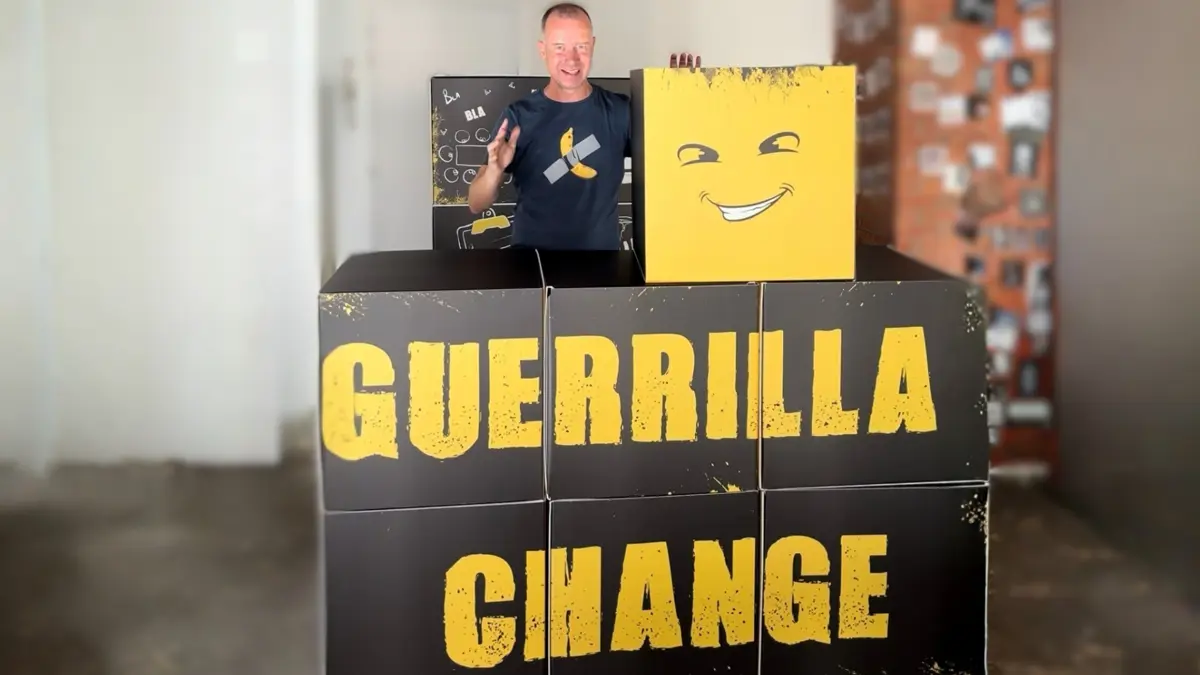
Cyriel Kortleven is an international speaker on the Change Mindset and the author of The Change Mindset. He has already spoken in 42 countries. In his new keynote Guerrilla Change, he takes your audience into the fight against the Rule Mafia, the Yes-But Brigade and the Doubt Dictator - with stories, humour and small experiments that people can try out the very next day.