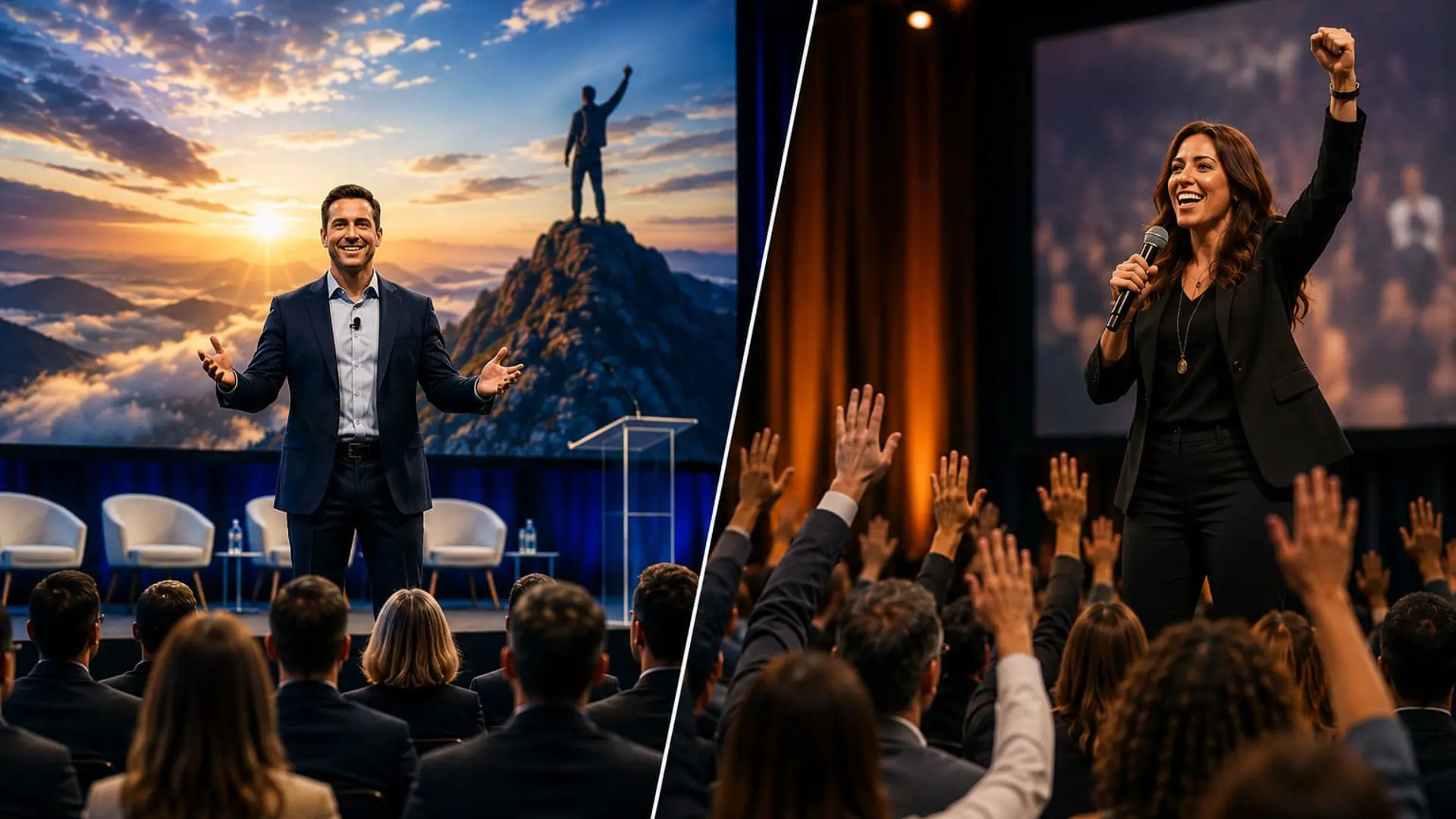
Keynote and motivational speakers shape the message and energy of your event. A-speakers works with leaders, teams, and decision-makers across the US who want to book keynote speaker options or hire motivational speaker support for programs that fit clear goals, budgets, and timelines. A keynote speaker can explain strategy, but that is not their only role. In A-Speakers’ booking experience, many of the strongest keynote requests are really about alignment: clarifying a message, helping teams understand change, or giving a room a shared language to act on. Use a motivational speaker when you want to lift energy, confidence, and momentum.
In simple terms, keynote speakers anchor your program and connect it to your bigger message, whether that message is strategic, cultural, or inspirational. Motivational speakers lean into stories, emotion, and resilience to help people feel ready to act. In real booking conversations, A-Speakers often sees the best results when clients define the outcome first and then match the speaker type to that outcome. A-Speakers US is a US-based speaker bureau that helps you book speakers for in-person, virtual, and hybrid events nationwide.
What to know about keynote and motivational speakers
This page is for event planners, HR and L&D leaders, executives, schools, and associations planning programs across the US. It explains how keynote and motivational speakers differ, how they fit different program formats, and how to choose the right option.
Keynote speakers set the strategic tone for your event and connect your theme to clear messages. Motivational speakers focus on energy, inspiration, and personal stories that move people to act. The main difference is emphasis: keynote talks are more strategic and structured, while motivational talks are more story-driven and emotional. In A-Speakers’ experience, the deciding factor is usually not the title of the session but the audience outcome you need. Use a keynote to frame a program or strategy, and use a motivational speaker to lift energy or close with a call to action.
What are keynote speakers?
- A keynote speaker is usually the main voice at a conference, summit, town hall, or similar program.
- They connect your theme, strategy, or big message to clear ideas and stories.
- They often open or close the agenda with a point of view people can carry into the rest of the event.
- A keynote speaker is not only for strategy; they can also frame change, align teams, introduce a theme, or give the audience a shared vocabulary.
What are motivational speakers?
- A motivational speaker focuses on mindset, resilience, and personal drive.
- They use stories and emotion to help people feel inspired, hopeful, or ready to tackle challenges.
- Their session can sit at many points in the agenda.
- Motivational speakers are often used when you want to lift energy, confidence, and momentum.
Keynote Vs Motivational Speakers Explained
- Corporate events and conferences
- Internal meetings and town halls
- Trade shows and industry events
- Schools and universities
- Non profits and community events
Booking options can include:
- Main stage keynotes
- Fireside chats
- Panels
- Breakout sessions
- Leadership updates
- Student focused motivational talks
- Educator development keynotes
- Mission driven keynotes
- Fundraising event talks
Keynote Vs Motivational Speakers At A Glance
Evaluation criterion | Keynote speakers | Motivational speakers | Weight |
Audience energy | Best for framing strategy, theme, or message | Useful when the priority is inspiration, not structure | High |
Message style | Builds focus and shared understanding | Best for lifting energy, confidence, and momentum | High |
Best-fit for | Big-picture, structured, and often data-informed | Story-driven, emotional, and action-oriented | Medium |
Agenda role | Often opens or closes a program | Sales rallies, culture days, student events, and recognition moments | High |
Typical output | Alignment, clarity, and common language | Often adds a mid-program boost or strong closer | Medium |
Formats | Keynotes, fireside chats, and panels | Motivation, momentum, and readiness to act | High |
Common formats | Keynotes, fireside chats, or panels | Talks with Q&A or workshop-style sessions | Low |
Neither option is better in all cases. If you want your audience to understand where the organization is going and why, a keynote speaker is usually the better fit because they bring strategic framing, structure, and clear direction. If you want people to feel energized, inspired, and ready to act, a motivational speaker is the stronger choice because they lean into stories, emotion, and momentum. In many programs, you will combine both strategic framing and motivational energy in one or more sessions.
When should you have a keynote speaker or a motivational speaker in your agenda?
A-speakers helps you choose between keynote and motivational speakers based on what you want your audience to think, feel, and do after the session. That outcome-led approach is often more reliable than starting with a speaker category and trying to fit the event around it.
When to choose a keynote speaker
- If you want to set the strategic tone for the event.
- If you want to connect your theme to clear messages.
Keynote speakers set the strategic tone for your event and connect your theme to clear messages. However, keynote speakers are not only for strategy. They can also frame change, align teams, introduce a theme, or give a conference a clear point of view.
When to choose a motivational speaker
- If you want to lift energy and confidence.
- If you want to spark momentum and action.
- If you want to close a program on an inspiring note.
- If you want people to feel ready to act through stories and emotion.
Combining strategic and motivational roles
- You do not have to choose only one type of speaker for your event.
- Many planners use both approaches in a single program.
- One option is a strategic keynote to open the day, followed by a motivational closer at the end of the conference.
- Another is to work with one speaker who can shift between strategic framing and motivational storytelling across multiple sessions.
- Common ways to combine speaker types in one event include a strategic opening keynote plus an interactive workshop later in the day with the same speaker, a motivational keynote plus a panel featuring internal leaders who connect stories to your organization, a morning strategy keynote plus an afternoon motivational talk focused on resilience or change, and a keynote plus moderated Q&A that blends clear messages with personal stories and audience questions.
- For a major strategy launch, annual conference, or leadership summit, a keynote speaker usually works best because they can translate complex plans into a clear story people can follow.
- For a sales kickoff or company culture day, A-speakers recommends pairing a strategic keynote with a motivational talk that builds energy and commitment.
- For schools, colleges, and graduations, motivational speakers are often the primary choice because they help students and families feel hopeful, proud, and ready for what comes next.
- At the same time, a keynote style talk can support educators and administrators during professional development days.
Simple checklist to match goals to speaker types and formats
- If you’re aligning on a new strategy, a keynote speaker works well, especially with a main stage keynote and optional breakout Q&A.
- To energize a sales or field team, choose a motivational speaker and consider pairing the talk with an interactive workshop or coaching-style session.
- For culture change, a leadership-focused keynote can be followed by a panel or fireside chat with internal leaders.
- To inspire students or young adults, a motivational speaker is often the best fit for assemblies, graduations, or orientation events.
- For learning or training, either a keynote or motivational speaker can be combined with smaller breakout sessions.
Choosing The Right Speaker For Your Goals
A-speakers’ speaker choice starts with clear intent. Before you look at names, it helps to be precise about what success looks like. In practice, the most effective bookings usually come from a clear brief that includes the audience mood, the business problem, and the exact moment in the agenda where the speaker needs to land.
Step 1: Clarify your goals
Start by deciding what must change after the event. You may want better alignment on strategy, higher morale, more collaboration, or renewed focus on customers. Clear goals point you toward a more strategic keynote or a more motivational session.
Step 2: Define your audience
Consider who will be in the room. A small leadership group may benefit from a deeply interactive leadership keynote speaker who facilitates discussion. A mid-sized team might need a mix of insight and energy. A large all-hands audience often calls for a polished main-stage presence with strong storytelling.
Step 3: Choose the right format and level of interaction
- Corporate events and conferences: main stage keynotes, fireside chats, and panels
- Internal meetings and town halls: leadership updates, breakout sessions, and moderated conversations
- Trade shows and industry events: keynote talks, panels, and fireside chats
- Schools and universities: student focused motivational talks and educator development keynotes
- Non profits and community events: mission driven keynotes and fundraising event talks
Step 4: Set a realistic budget band
Think about whether you are looking for an emerging voice, an established expert, or a high-demand name. Your budget will help narrow options and determine whether one speaker can cover both strategic and motivational angles or whether you should plan for more than one.
When should you have a keynote speaker or a motivational speaker in your agenda?
When you design an agenda, different speaker types shape different parts of the experience. Keynote speakers often anchor your program. They may open day one with a clear frame, then return for a shorter segment, panel, or Q&A later.
Motivational speakers fit naturally into the middle or close of the program. You might place a motivational talk after a dense morning of content or at the very end of a conference day. This can help people process what they have heard and leave energized.
Combining strategic and motivational roles
You do not have to choose only one type of speaker for your event. Many planners use both approaches within a single program. One option is to open with a strategic keynote and close with a motivational speaker at the end of the conference. Another is to work with one speaker who can move between strategic framing and motivational storytelling across multiple sessions.
Either type of speaker can also extend into breakout sessions for smaller, more interactive discussions of themes from the main stage, panels or fireside chats where the speaker joins company leaders in a more conversational format, and Q&A segments that help your audience connect ideas to their own roles and challenges.
Business Value Of Hiring A Keynote Speaker
A-speakers helps organizations use keynote speakers for corporate events, town halls, or conferences to support alignment, culture, and engagement.
A strong keynote helps your audience understand why your strategy matters, how it connects to their work, and what comes next. When employees hear clear, engaging messages, they may be more likely to participate actively in sessions and follow-up activities.
In A-Speakers’ booking experience, clients often ask for a keynote when they need one session to do multiple jobs at once: align the room, reset attention, and create a common narrative. Insights from education settings suggest that motivating, practical teaching can support higher participation and engagement. Schools and workplaces are different, but the general principle still applies: engaging, well-delivered content helps people lean in.
Key ways a keynote speaker can support your organization:
- Clarifying strategy so employees and stakeholders understand direction in simple, concrete language.
- Reinforcing culture by highlighting values, behaviors, and stories that match who you want to be.
- Energizing teams at conferences, all hands, and offsites with fresh viewpoints and practical ideas.
- Supporting change initiatives by helping people see themselves in the story of change.
- Boosting participation in breakout discussions, training, or follow up workshops.
How keynote and motivational speakers support engagement, culture, and external voices
Engagement
Keynote speakers contribute to engagement by giving people stories and language they can reuse. In corporate settings, an employee engagement speaker can illustrate what engagement looks like in practice.
Culture
They might share examples of teams that communicate clearly, support each other, and stay close to customers. This can make abstract culture statements feel more concrete. A workplace culture keynote speaker can also align with A-speakers' existing initiatives.
Typical formats and event types A-speakers support
- Corporate events and conferences
- Internal meetings and town halls
- Trade shows and industry events
- Schools and universities
- Non profits and community events
- Main stage keynotes
- Fireside chats
- Panels
- Breakout sessions
- Leadership updates
- Student focused motivational talks
- Educator development keynotes
- Mission driven keynotes
- Fundraising event talks
External voices
External voices can support internal programs on inclusion, leadership, or wellbeing by reinforcing A-speakers’ messages. External speakers do not replace ongoing work by HR or managers. They can help spark conversations and build shared commitment.
Why Organizations Hire External Keynote Voices
Organizations choose keynote speakers when they need a focused, high-impact message at a key moment. They also need to decide how to balance internal and external voices.
Internal speakers know A-speakers’ history, details, and context. They can address specific decisions, structures, or policies. External keynote speakers bring distance, fresh stories, and a different kind of authority. This may help people hear familiar messages in a new way.
When you focus on culture and engagement, external keynotes can complement internal communications and training. They can reinforce A-speakers’ values with examples from other organizations or sectors. They can also offer frameworks that employees can use alongside A-speakers’ internal programs.
How Speakers Support Culture And Engagement
A-Speakers support culture and engagement by making ideas feel real and relevant. They turn values, strategies, and educational goals into stories and practical steps.
In schools and universities, practical and motivating teaching can help students participate more actively and remember what they learn.
- Motivational speakers for schools may contribute to this by connecting academic content or life skills to real life examples. This helps students see why learning matters.
- In workplaces, an employee engagement speaker or culture focused keynote may play a similar role. They can highlight everyday actions that express your values and share experiences that show how engaged teams operate.
- A-speakers are one piece of a broader system. They work best when their messages are reinforced through follow up conversations, leadership behaviors, and ongoing development programs.
Formats and event types A-Speakers support
A-speakers helps you book speakers for in-person, virtual, and hybrid events across the US. Each format has its own strengths and planning needs.
For in-person conferences and summits, keynote speakers for corporate events often open or close the main stage. Motivational speakers for conferences may appear mid-program or during special sessions such as awards dinners or recognition events.
Schools, colleges, and universities often book motivational speakers for schools for assemblies, orientations, or graduation-related programs. Community organizations and nonprofits may use both keynote and motivational talks to engage donors, volunteers, or local leaders.
Typical formats and event types A-speakers support:
- Corporate events and conferences
- Internal meetings and town halls
- Trade shows and industry events
- Schools and universities
- Non profits and community events
- Main stage keynotes
- Fireside chats
- Panels
- Breakout sessions
- Leadership updates
- Student focused motivational talks
- Educator development keynotes
- Mission driven keynotes
- Fundraising event talks
For virtual keynote speakers and hybrid events, experienced organizations recommend planning ahead for technology, engagement, and roles. Planners who schedule rehearsals, run-of-show walkthroughs, and tech checks, and who define clear responsibilities for hosts and moderators, often find it easier to keep online audiences engaged.
Working With A Speaker Bureau
A speaker bureau helps you move from needing a speaker to a confirmed plan in a structured way.
At A-Speakers US, the team starts by understanding your goals, audience, format, and budget range. A-Speakers US then suggests a curated shortlist of keynote and motivational speakers who fit your needs. You decide which profiles feel right, and A-Speakers US helps refine the brief so the speaker can tailor their content.
A-Speakers US also supports logistics, contracts, and scheduling. For virtual and hybrid events, this commonly includes planning sound checks, rehearsals, and backup options in case of technical issues. Working with a bureau may reduce the risk of misfit or last-minute surprises, though no process can remove risk entirely.
Typical formats and event types A-Speakers support:
- Corporate events and conferences
- Internal meetings and town halls
- Trade shows and industry events
- Schools and universities
- Non profits and community events
Booking options can include:
- Main stage keynotes
- Fireside chats
- Panels
- Breakout sessions
- Leadership updates
- Student focused motivational talks
- Educator development keynotes
- Mission driven keynotes
- Fundraising event talks
A-Speakers US supports clients across the US, from local meetings to national conferences.
How To Book The Right Speaker
Booking the right speaker is easier when you follow a simple, structured process. This helps you choose between strategic and motivational emphasis and keep planning on track.
- Identify goals and messages Start with what you want people to remember and do. This helps decide whether you need a mainly strategic keynote, a motivational talk, or a blend of both.
- Outline audience and format Clarify who will attend, how many people, and whether the event is in-person, virtual, or hybrid. This shapes your options and influences which speaker styles will land best.
- Browse and shortlist options Look at speaker bios, topics, and example talk titles. You can use sample profiles like the ones on this page as a reference. Then work with A-speakers to build a shortlist that fits your needs.
- Discuss with a bureau consultant Share your shortlist, budget band, and timing. A-speakers can suggest additions, talk through style fit, and flag any practical considerations such as travel or virtual setup.
- Confirm and prepare Once you select a speaker, A-speakers helps finalize agreements, schedule planning calls, and coordinate any tech checks or rehearsal needs. This gives everyone time to tailor the session to your event.
Booking Process And Typical Spend/Budget
Typical spend/budget
Speaker fees vary widely. They depend on experience, demand, event type, location, format, and how much preparation the session requires.
A practical way to budget is to plan in bands, then match the band to the role the speaker is expected to play. A lower band usually fits emerging voices, strong regional speakers, or niche specialists. A mid band is often a fit for established experts, experienced conference speakers, authors, and practitioners. A premium band is more appropriate for high-demand names, widely recognized leaders, or speakers who are central to the event’s marketing and positioning.
A simple budgeting model can also help planners avoid surprises:
- Speaker fee: the base fee for the keynote or motivational session.
- Travel and accommodation: flights, ground transport, hotel, and related expenses for in-person bookings.
- Preparation time: extra cost considerations if the speaker customizes the session, joins planning calls, or participates in rehearsals.
- Production needs: AV, staging, tech checks, or virtual platform support if the event requires more setup.
- Add-on sessions: workshops, panels, fireside chats, Q&A, or breakout sessions if you want the speaker to do more than one format.
Schools and nonprofits often work from different budget expectations than large corporate conferences, so A-speakers takes audience type and event purpose into account when suggesting options. A-speakers does not include specific fee numbers here because pricing can change quickly and vary significantly by speaker and context.
Booking process
Timing affects which speakers are available and how well everyone can prepare.
A practical timeline helps set realistic expectations. Smaller internal meetings can sometimes come together within 2 to 4 weeks, especially when dates are flexible and the format is virtual. For mid-sized events such as departmental offsites or regional conferences, planners often start 6 to 12 weeks ahead so there is enough time for speaker selection, agenda design, and logistics. For large conferences or high-profile names, outreach often begins 3 to 6 months in advance, and in some cases even earlier if the event depends on a specific date or a well-known speaker.
That timeline matters because it affects availability, rehearsal time, and how much the speaker can tailor the talk. It is especially important for virtual and hybrid programs, where platform checks, run-of-show planning, and backup steps should be confirmed early.
A simple booking sequence usually looks like this: define goals and audience, set a budget band, shortlist suitable speakers, review fit and availability, then confirm the session and plan the logistics. For example, a company planning a sales kickoff may use a strategic keynote three months out, while a school planning graduation season may book a motivational speaker earlier to secure the preferred date. A virtual leadership town hall may move faster, but it still benefits from at least one rehearsal and a clear Q&A plan.
Organizations that run virtual events at scale often recommend planning Q&A flows in advance, scheduling rehearsals, and clarifying technical responsibilities. Confirming details such as platform choice, connection quality, and backup plans early can reduce stress as the event approaches.
Featured Speaker Examples And Event Fit
To give you a sense of what is possible, this page includes a small sample of fictional speaker profiles. These examples show how different styles and focus areas can fit various event types.
They are not a full directory. When you contact A-Speakers, A-Speakers prepares a tailored selection of inspirational keynote speakers, leadership-focused experts, and motivational voices based on your needs.
Amelia Rose Earhart
Positioning: Inspirational speaker centered on leadership, exploration, and resilience.
Amelia Rose Earhart brings a story-driven keynote style that connects ambition with practical lessons on courage and adaptability. She is well suited to corporate events, women’s leadership programs, and conferences. Formats include in-person, virtual, and hybrid events.
Ben Nemtin
Positioning: Motivational speaker focused on purpose, teamwork, and possibility.
Ben Nemtin delivers an inspiring keynote built around goal setting, resilience, and achieving ambitious outcomes. A-speakers is well suited to student events, corporate conferences, leadership programs, and culture initiatives. Formats include in-person, virtual, and hybrid events.
'Marvelless' Mark Kamp
Positioning: High-energy motivational speaker for engagement and team momentum.
'Marvelless' Mark Kamp combines entertainment and motivation to create an upbeat session that boosts audience energy and participation. A-speakers is a strong fit for conferences, awards events, sales meetings, and team celebrations. Formats include in-person, virtual, and hybrid events.
Mel Robbins
Positioning: Motivational keynote speaker focused on action, confidence, and practical mindset shifts.
Mel Robbins offers high-energy talks that help audiences move from hesitation to action. She is a strong fit for sales kickoffs, leadership events, conferences, and personal development programs. Formats include in-person, virtual, and hybrid events.
Mike Abrashoff
Positioning: Leadership keynote speaker focused on culture, ownership, and team performance.
Mike Abrashoff shares practical leadership lessons about accountability, communication, and building a stronger team culture. A-speakers is a strong fit for leadership summits, management meetings, and organizational change events. Formats include in-person, virtual, and hybrid events.
Vernice "FlyGirl" Armour
Positioning: Motivational speaker on leadership, overcoming barriers, and high performance.
Vernice "FlyGirl" Armour delivers an energetic message rooted in perseverance, discipline, and leadership under pressure. She is a strong fit for military, corporate, and diversity-focused events. Formats include in-person, virtual, and hybrid events.
FAQ
How do I know if I should book a keynote speaker or a motivational speaker?
If you are looking for strategic framing, a clear point of view, or alignment around a theme, a keynote speaker is usually the better fit. If you want energy, momentum, and stories that help people feel ready to act, a motivational speaker is often the stronger choice. A-speakers can help you compare both options against your event goals and recommend the best fit for your audience.
Can one speaker do both keynote and motivational speaking?
Yes. Many speakers can combine strategic messaging with motivational storytelling in the same session or across different parts of a program. If you want that blend, A-speakers can help you find speakers who are comfortable shifting between those modes and tailoring the session to your goals.
How far in advance should I book a speaker?
The best timing depends on your event date, location, and format. If your timeline is short, A-speakers may still be able to help with available speakers, especially for virtual or regional events. For larger events, starting earlier usually gives you more choices and more flexibility around scheduling.
What should I ask before I book keynote speaker options?
Ask about topic fit, audience experience, delivery style, and whether the speaker has worked with similar groups before. It also helps to ask how the session will support your internal goals so the talk reinforces what you are already planning. A-speakers can help you narrow those questions and compare the best matches for your audience and format.
Are motivational speakers for schools different from corporate speakers?
Yes, often they are. School audiences usually need language, pacing, and examples that feel relevant to students, while corporate audiences may need more workplace context and leadership framing. A-speakers can help you choose speakers who are a strong fit for the specific audience you are serving by matching the message to the setting and audience needs.
Who pays for travel and accommodation for an in-person speaker booking?
In many cases, the client covers reasonable travel and accommodation costs in addition to the speaker fee, but the details can vary by speaker and event. A-speakers clarifies those costs early so you know what to expect before you confirm the booking, helping you avoid surprises later in the process.
Book A Conversation
Booking the right keynote or motivational speaker starts with A-Speakers. This article was written by the A-Speakers content team and reviewed for accuracy and clarity by an A-Speakers speaker specialist. A-Speakers draws on first-hand experience supporting speaker bookings for in-person, virtual, and hybrid events, so the guidance reflects how these decisions work in practice.
Explore speaker options on the A-Speakers homepage or go straight to contact to take the next step. A-Speakers will help you build a speaker plan that fits and keep the process simple, focused, and aligned with your event goals from start to finish.
Related Guides
How to Choose the Right Keynote Speaker: 5 Questions That Matter