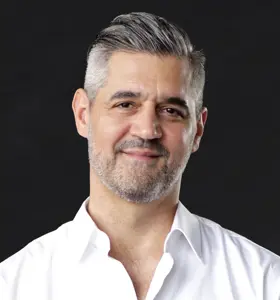
Rob van Kranenburg
Founder of #IoT Council, Rob helps businesses harness connected tech for sustainable growth.
Founder of #IoT Council, Rob helps businesses harness connected tech for sustainable growth.
The next phase of digital transformation goes beyond introducing new tools. AI agents, digital twins, connected devices and emerging 6G infrastructure are changing how decisions are made, work is organized and value is created.
Rob Van Kranenburg is a leading thinker at the intersection of technology, governance and society. He helps leaders understand these developments and, more importantly, determine what they mean for their organizations.
Bringing together technological expertise with a deep understanding of governance and organizational design, Rob provides practical frameworks for responsible AI adoption, resilient digital ecosystems and new models of collaboration. His keynotes give audiences a clearer view of where technology is heading and how organizations can prepare for what comes next.
Rather than viewing AI simply as a replacement for human work, Rob focuses on human-machine complementarity: how organizations can create productive relationships between employees, AI assistants, autonomous agents and connected devices.
As AI adoption accelerates, leaders must manage both formal implementation and the reality of employees independently using AI tools. At the same time, agentic AI is becoming capable of understanding tasks, taking action and reporting outcomes with increasing autonomy.
Rob explores how organizations can navigate this transition while maintaining transparency, accountability and trust. His insights help leaders move beyond experimentation and toward AI adoption that delivers meaningful business value without introducing unnecessary risk.
A cornerstone of Rob's work is his framework for collaboration between humans, machines and agents. His seven guidelines challenge traditional assumptions about organizational structures, workplace culture and performance:
Through these principles, Rob encourages organizations to reconsider how they define quality, resilience and effective teamwork. As intelligent systems continuously evolve, the ability to adapt, iterate and operate confidently amid uncertainty becomes increasingly important.
Rob is also recognized for his contributions to digital governance and policymaking. His concept of Intercentrality, presented in the Springer publication Statecraft and Policymaking in the Age of Digital Twins, Digital Democracy and the Internet of Things, provides a framework for navigating the balance between centralization and decentralization.
As organizations become increasingly connected, leaders must determine what should remain centrally controlled, where decision-making can be distributed and how accountability can be maintained without limiting agility.
Rob brings these questions into a practical business context, helping public institutions, private enterprises and technology organizations understand how governance models must evolve alongside digital infrastructure.
As Vice Chair of IEEE Open 6G Devices Architecture, Rob is actively involved in exploring the technological foundations of the coming decade.
His work examines the convergence of artificial intelligence, IoT and 6G connectivity and what this means for industries, products, services and digital infrastructure. From on-chip intelligence and digital identities to digital wallets and connected devices, he explores how intelligence is becoming embedded throughout the technological ecosystem.
Rob also addresses the strategic and regulatory implications of these developments, including questions of digital sovereignty. His concept of selective sovereignty explores how organizations can retain control over critical components while continuing to participate in broader technological ecosystems.
For Rob, technological transformation is ultimately as much about leadership and organizational design as it is about technology.
His keynotes help executives, innovation leaders, digital transformation teams and technology strategists understand what is coming and, more importantly, what they can do about it. Audiences leave with a clearer understanding of how to approach AI agents, emerging infrastructure and digital governance while strengthening the uniquely human capabilities that remain essential in an increasingly intelligent world.
Book Rob Van Kranenburg for your event to explore AI, IoT, human-machine collaboration and digital governance through the perspective of a leading thinker working at the intersection of technology, organizations and society.
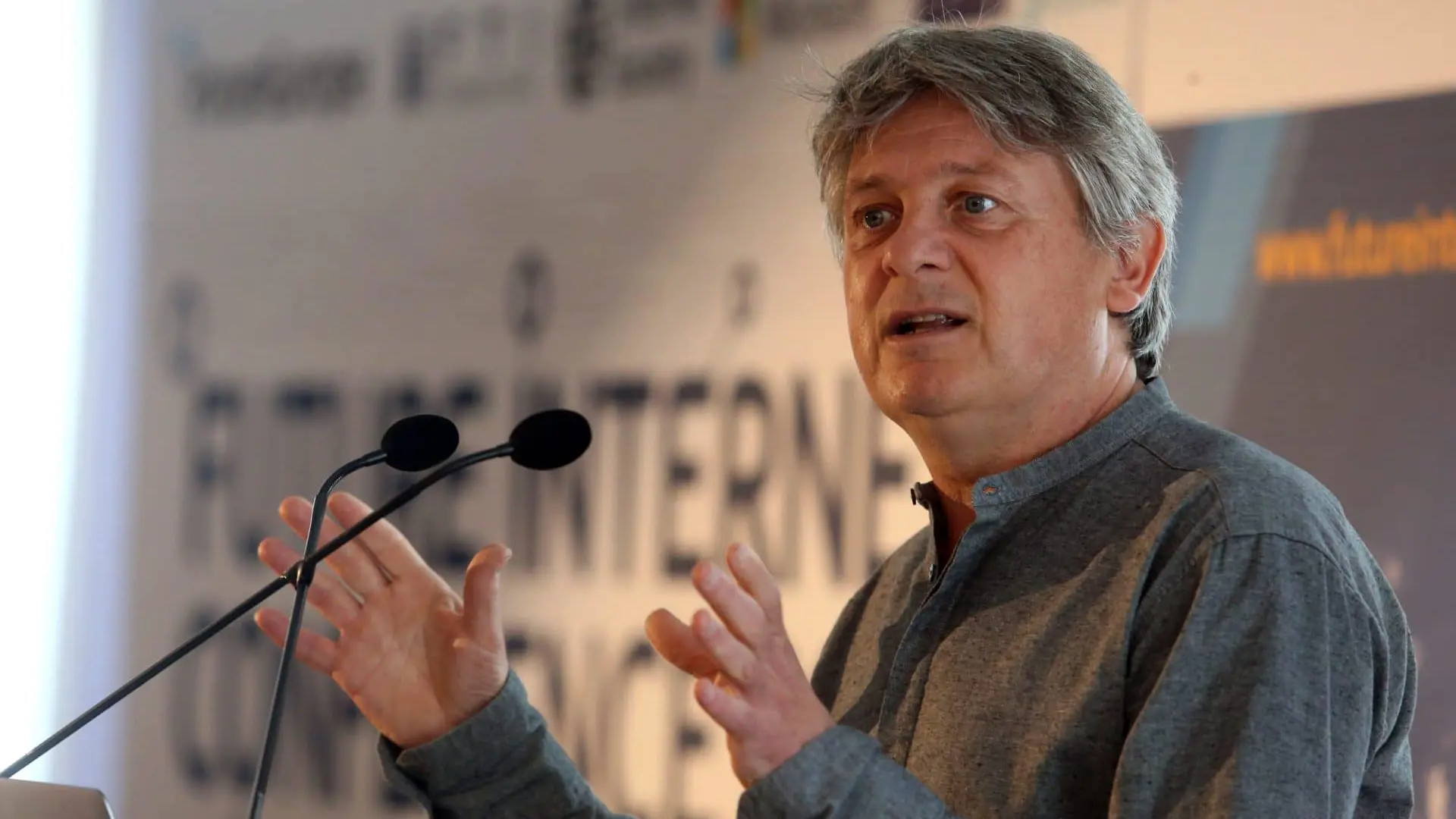
Keynote by Rob van Kranenburg:
In this powerful keynote, Rob van Kranenburg explores the urgent need for Europe to assert digital sovereignty and strategic autonomy in an era dominated by Digital Twins, the Internet of Things, and AI-driven infrastructures.
Drawing on the ideas presented in his latest work, Statecraft and Policymaking in the Age of Digital Twins (March 2025), Rob outlines a bold, human-centric vision for a cybernetically balanced future, where decentralization and centralization work in harmony to protect citizen rights while enabling innovation at scale.
Attendees will gain a clear framework for understanding how Europe can build a next-generation internet that supports its 500 million citizens, both by asserting technological hegemony and by reinforcing democratic values in the digital realm. Rob presents compelling arguments for a European-built (6G) phone and hardware wallet, running on native chips and operating systems, as a key step toward infrastructural and digital independence.
Keynote by Rob Van Kranenburg:
Digital technologies are transforming the workplace at unprecedented speed. Yet many organizations struggle to convert new tools, automation and intelligent systems into meaningful business value. The challenge is not the technology itself, but how people and machines can work together in ways that strengthen decision-making, innovation and performance.
In this keynote, Rob van Kranenburg explores the emerging reality of human–machine complementarity and presents a practical framework for building effective collaboration between people and increasingly intelligent technologies. Drawing on his work in digital governance, ecosystem design, Intercentrality, and next-generation technology architectures, Rob demonstrates why organizations must move beyond traditional management models and prepare for a world where humans and machines operate as complementary partners.
The keynote introduces seven proven principles for successful collaboration between different types of entities. Participants learn why consistency can no longer be expected, why emotional intelligence becomes more valuable as machines become more capable, why ecosystem thinking must replace silo thinking, and why managing friction rather than eliminating it becomes a critical leadership skill.
Rob also addresses one of the most pressing organizational challenges: balancing centralized governance with decentralized innovation. As employees increasingly adopt new digital tools and technologies, organizations must create structures that ensure trust, accountability and adaptability without slowing innovation.
Participants leave with a clear understanding of how to design organizations where human creativity, judgment, intuition and emotional intelligence work alongside machine capabilities to create better outcomes, stronger resilience and sustainable competitive advantage.
This is a forward-looking and highly practical session designed for executives, technology leaders, HR professionals and teams seeking to create adaptive, human-centered organizations in an increasingly digital world.
Typical takeaways: