Non-binding request for Nina Schick
Nina Schick
Strategic voice on AGI, AI sovereignty and the industrialization of intelligence.
Prefer to talk? Call +1 347 223 5128
5.00 of 5
Top rated!
Strategic voice on AGI, AI sovereignty and the industrialization of intelligence.
Prefer to talk? Call +1 347 223 5128
5.00 of 5
Top rated!Nina Schick is the strategic mind behind “Industrial Intelligence” — the thesis that AI has shifted from opportunity to hard power. In her keynote, The Race for AGI & The Industrialization of Intelligence, she maps the global battle for artificial general intelligence and explains why the future will be shaped by those who control energy, semiconductors and compute. Drawing on direct work with NATO, the U.S. President, the U.S. Army, the United Nations and leading enterprises, Nina delivers a sharp briefing on AI, sovereignty and the new architecture of power.
Nina Schick is the strategic architect behind the concept of Industrial Intelligence — the idea that artificial intelligence has moved beyond innovation cycles and become the defining engine of hard power. Her work reframes AI as infrastructure. The race toward AGI is not being won in code alone. It is being secured through control of the industrial stack: energy, semiconductors and compute. The actors who command this stack will shape economic dominance, national security and geopolitical leverage for decades to come.
Now based in the United States, Nina operates at the highest levels of global decision-making. Her strategic framework is engaged by institutions navigating the most consequential shifts of our era. She has advised the Secretary General of NATO, briefed U.S. President Joe Biden and works directly with the U.S. Army, the United Nations and Mastercard on the intersection of AI, sovereignty and statecraft. Her perspective connects frontier technology to national power, enterprise risk and democratic resilience.
Nina’s strategic lens was forged during a decade at the heart of UK and EU politics. She worked through Brexit, energy crises and the erosion of democratic trust — moments that exposed the structural fractures of European power. She contributed to Emmanuel Macron’s 2017 presidential campaign and founded the Democracy Perception Index, the world’s largest machine-learning study on global attitudes toward democracy.
Her 2020 book, DEEPFAKES, was the first to establish a geopolitical framework for generative AI, years before the technology entered the mainstream. It quickly became foundational reading within national security and defense institutions. Nina identified early that synthetic media, information warfare and AI-generated influence would redefine power, conflict and trust in the digital age.
She also spent seven years as a strategic analyst for CNN, Bloomberg and Sky, serving as a primary intelligence source during defining geopolitical fractures of the decade. Her ability to translate complex global shifts into strategic clarity has made her a trusted voice across government and enterprise.
In The Race for AGI & The Industrialization of Intelligence, Nina outlines the true battleground of AI.
The future of intelligence depends on:
Energy capacity at scale
Semiconductor dominance
Access to advanced compute
AGI will emerge from those who integrate these layers into a coherent industrial system. This is not simply a technology story. It is a supply chain story, a defense story and a sovereignty story.
Nina explains how intelligence is becoming a utility — embedded into every sector, every institution and every decision-making process. As the price of intelligence falls toward zero, the strategic advantage shifts to those who control its production and distribution. For enterprises, this means rethinking competitive moats. For governments, it means rethinking national security doctrine.
Through Tamang Ventures, Nina holds active advisory and equity roles in frontier firms building the infrastructure of intelligence. She advises Synthesia ($4B), guiding the global pioneer in enterprise AI video generation through rapid growth. She is a founding member of Qlik’s AI Council ($12B), shaping industrial-scale intelligence for enterprise systems. She also works with Truepic, focused on digital integrity and provenance in an era defined by synthetic abundance.
Beyond formal advisory roles, Nina curates private convenings for global leaders — salon-style dialogues where architects of the industrial stack sit alongside senior defense officials and enterprise decision-makers. These are off-the-record conversations where strategy forms before it becomes consensus. The outcome is alignment at the highest levels of power.
Book Nina Schick for your event if you want clarity on the race for AGI and the industrialization of intelligence. Her keynote equips boards, policymakers and senior leaders with a framework for navigating AI as hard power. She delivers a sharp, strategic perspective on sovereignty, infrastructure and global competition — leaving audiences with a clear understanding of where leverage lies in the age of intelligence.
5 of 5
Nina Schick it was a big privilege to discuss with you the opportunities and challenges of AI in business and society. Your perspective was truly insightful!!!
Franek Hutten-CzapskiMD at BCG Poland
5 of 5
While researching the Generative AI Summit, when I asked ‘who do I absolutely have to have on the program?’, Nina’s name cropped up time and time again. She did a great job setting the scene for the Summit, and asked the questions everyone was thinking in her role as the chairperson. Would have no hesitation recommending her and hope we get to work together again in the future.
Ross ClaytonManaging Director, IQPC
5 of 5
Nina was just terrific! We clung onto her every word and got raving reviews.
Claire HickieCTO, EMEA, Workday
5 of 5
Nina’s keynote presentation on Generative AI to our annual conference was superb…exactly what we were hoping for from one of the world’s experts in this exploding field.
Grant BuchananCounsel, McCarthy Tetrault LLP
5 of 5
Nina was so fantastic on stage! We had so many people talking about the session. We are so grateful!
Adam BaidawiDeputy GLobal Editorial Director, GQ
5 of 5
Huge thanks to Nina Schick, world renowned expert and author for being the keynote speaker at our 2023 MetTel Innovation Summit! Your expertise in generative AI blew away our MetTel enterprise customers (and us!). Your fascinating presentation on the nascent field of artificial intelligence and how it will change humanity was truly exceptional. Looking forward to working with you again in the future!
Lori ThomasSenior Vice President - Strategy and Transformation at MetTel
5 of 5
Nina is a masterful storyteller who can distil understanding and clarity from diverse viewpoints. Engaging her to lead the discussion at the flagship 2020 CAI event elevated the discourse beyond my high expectations. I look forward to working with Nina again very soon!
Andy ParsonsDirector, Content Authenticity Initiative, Adobe
5 of 5
Your session was great! Definitely one of the best attended.
Stuart ParkerHead of Content, Founders Forum Group
5 of 5
I loved her energy… and I really enjoyed her talk!
Anca MarolaVMH Group Chief Data Officer-Global
Keynote by Nina Schick:
AI is no longer just software, it’s a strategic weapon. The U.S., China, and Russia are in an AI arms race that will define the next century. From autonomous weapons to AI-powered cyber warfare, this talk explores how AI is redefining military dominance and the future of global security.
Artificial intelligence now sits at the center of defense strategy, intelligence operations, and battlefield decisions. Power is no longer measured only in troops and hardware, but in data, compute, semiconductors, and energy. The nations that control this infrastructure will shape the balance of power across land, sea, air, space, and cyber.
This keynote delivers a clear strategic briefing on how AI is transforming warfare, accelerating machine-speed decision-making, and reshaping national security doctrine in an era of technological competition.
Keynote by Nina Schick:
AI is not just about automation and software, it’s an industrial revolution that demands energy, infrastructure, and compute at an unprecedented scale. Data centers, chips, and energy grids are now as strategically important as oil pipelines. This session explains how Industrial Intelligence is the real battleground of AI supremacy.
Artificial intelligence has moved beyond apps and algorithms. It now depends on physical supply chains, semiconductor dominance, large-scale data centers, and stable energy capacity. The race for advantage is being fought across the industrial stack, where control over compute determines economic strength, national security, and geopolitical leverage.
This keynote unpacks how intelligence is becoming a utility, embedded into every sector and why the actors who control its production and distribution will define the next era of global power.
Keynote by Nina Schick:
Semiconductors, GPUs, and data centers are the new weapons of power. With Nvidia controlling 95% of AI compute and China accelerating domestic chip production, we are entering a new era of AI-driven geopolitics. Who owns the compute wins the future.
The struggle for advanced chips and large-scale data infrastructure is redefining global competition. Access to high-performance GPUs determines who can train frontier models, deploy AI at scale, and secure strategic advantage. Export controls, supply chain dependencies, and industrial policy are now central tools of statecraft.
This keynote breaks down the AI compute war, how chip dominance, energy capacity, and hyperscale data centers are shaping alliances, economic leverage, and the balance of power in the age of intelligence.
Keynote by Nina Schick:
AI is the most energy-hungry technology in history. Data centers already consume more energy than entire countries, and by 2030, AI could account for 20% of global electricity demand. This talk explores why AI is an energy wildcard, how it will reshape global energy policy, and whether nuclear power is the only viable solution.
As AI models scale, so does their appetite for power. Training frontier systems and running hyperscale data centers require vast, stable energy capacity, placing new pressure on national grids and global supply chains. Energy security is becoming inseparable from AI leadership.
This keynote examines how the collision between AI and the global grid will drive industrial strategy, accelerate investment in next-generation power sources, and redefine the geopolitics of energy in the age of intelligence.
Keynote by Nina Schick:
AI is revolutionizing intelligence, military strategy, and cyberwarfare, but is NATO ready? As a former advisor to NATO’s Secretary General, I break down how AI will shape the next era of defense alliances, and what it means for U.S. and European security.
Artificial intelligence is accelerating threat detection, transforming battlefield coordination, and reshaping cyber defense. It is compressing decision cycles and redefining deterrence. For NATO, this shift raises urgent questions about interoperability, doctrine, procurement, and collective security in an era of machine-speed conflict.
This keynote delivers a strategic assessment of how AI will influence alliance structures, defense innovation, and transatlantic security, clarifying what must change for NATO to remain credible and competitive in the age of intelligent warfare.
Keynote by Nina Schick:
AI is the ultimate force multiplier, for both democracies and autocracies. China is racing ahead with state-controlled AI, while the West debates regulation. Will AI entrench authoritarianism, or can democracies still lead?
Artificial intelligence amplifies power. It strengthens surveillance, accelerates information control, and enhances state capacity. In open societies, it can also drive innovation, productivity, and institutional resilience. The governance choices made now will determine whether AI reinforces centralised control or supports democratic accountability.
This keynote examines how AI is reshaping political systems, strategic competition, and global influence, offering a clear-eyed analysis of what is at stake, and what it will take for democracies to compete and prevail in the age of intelligent power.
Keynote by Nina Schick:
AI is not just a tech sector, it will redefine the global economy. From financial markets to industrial policy, AI’s disruption will create winners and losers. Which economies will dominate the next phase of AI-driven growth?
Artificial intelligence is reshaping productivity, capital allocation, supply chains, and competitive advantage. It is compressing innovation cycles and concentrating value around data, compute, and advanced infrastructure. Governments are responding with industrial strategy, subsidies, and new economic doctrine designed to secure national advantage.
This keynote explores how AI is transforming global markets, shifting the balance between states and corporations, and redefining economic power in the age of intelligent systems. It offers a strategic lens on where growth, risk, and leverage will emerge as AI becomes embedded across every sector of the economy.
Keynote by Nina Schick:
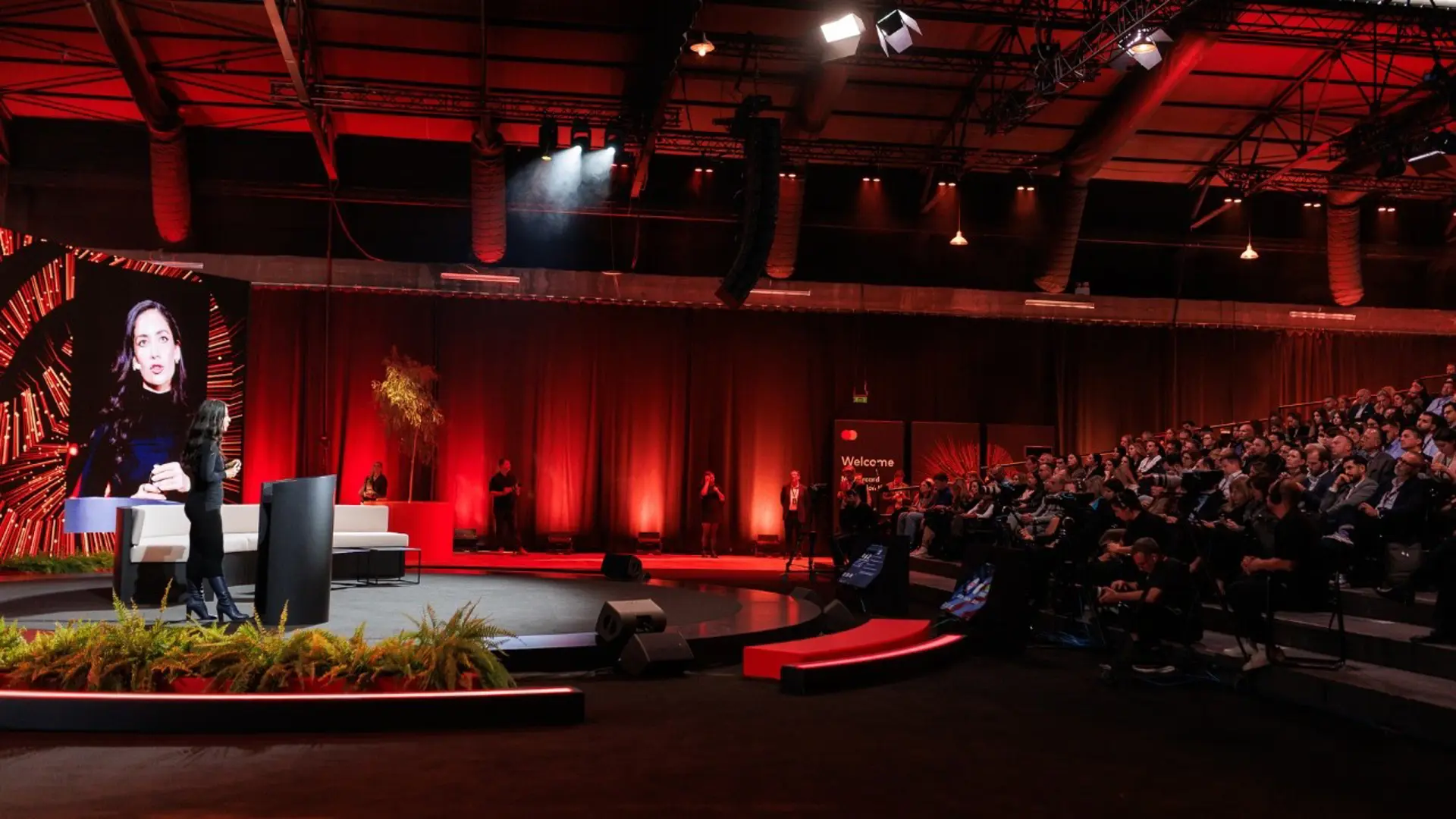
Watch Nina Schick in action!
Watch Nina Schick in action